

Calibration enquiries, quotations and bookings: write to the laboratory or contact the Head of Laboratory.
RFspin Calibration Laboratory is accredited by the Czech Accreditation Institute (Český institut pro akreditaci, ČIA) to ČSN EN ISO/IEC 17025:2018 as Calibration Laboratory No. 2433. Certificate of accreditation No. 453/2026 was issued on 6 October 2026 and is valid until 6 October 2029.
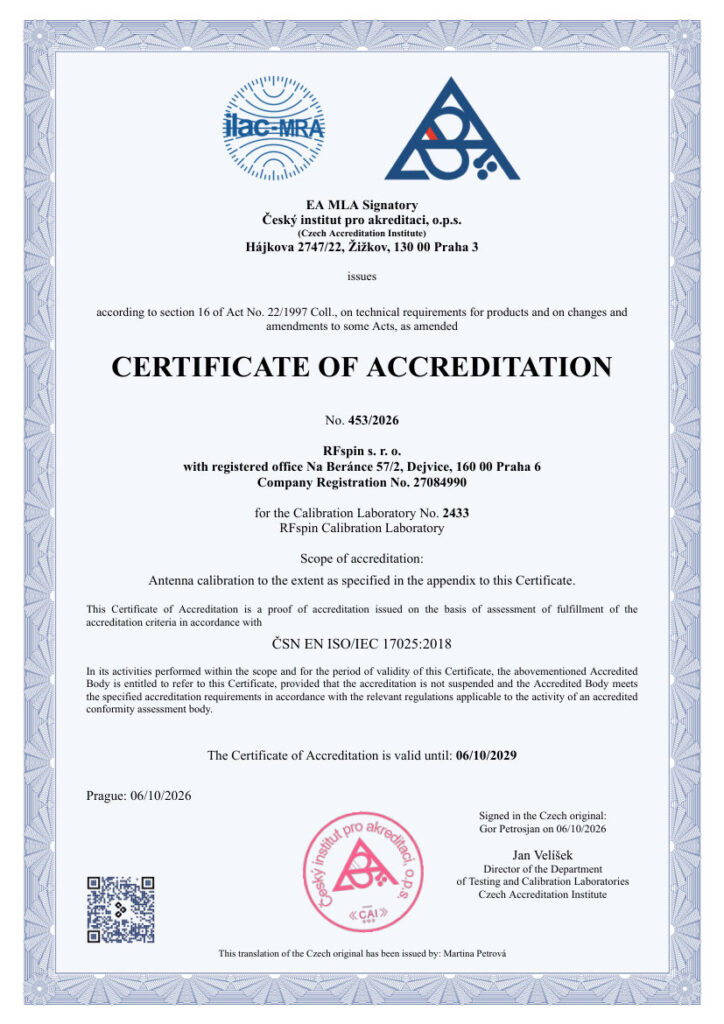
Scope of accreditation
−10 to 40 dB
Antenna gain
−16 to 72 dB(m⁻¹)
Antenna factor
0 to −35 dB
Reflection coefficient
0.7 dB
Gain · best uncertainty
0.7 dB
Antenna factor · best uncertainty
0.21 dB
Reflection coefficient · best uncertainty
1 m / 3 m
Gain · three-antenna method
1 m / 3 m
Antenna factor · three-antenna method
VNA
Reflection coefficient · vector network analyzer
All quantities are accredited from 500 MHz to 40 GHz. Best uncertainties are expanded uncertainties (k = 2); a particular calibration may have a higher uncertainty. The full scope is set out in the appendix to the certificate, included in both PDFs.
RFspin Calibration Laboratory welcomes feedback from customers and from anyone affected by our calibration activities. Every complaint is handled impartially, confidentially, and in accordance with ISO/IEC 17025.
Your name and contact details
The calibration certificate number or service concerned
A description of the issue and the outcome you expect
Acknowledgment. We confirm receipt within 5 business days.
Impartial review. Your complaint is assigned to a person not involved in the original work.
Investigation. We review the relevant records, methods and equipment data.
Decision and response. We communicate our decision in writing within 30 business days and, where appropriate, issue a corrected certificate.
Records. Every complaint and its resolution is documented and reviewed.
The laboratory calibrates antennas. Gain, antenna factor and reflection coefficient are calibrated within the scope of our accreditation to ČSN EN ISO/IEC 17025:2018; other measurements are provided outside the scope of accreditation.
Your calibration certificate carries the ČIA accreditation mark.
Gain from −10 to 40 dB and antenna factor from −16 to 72 dB(m⁻¹), 0.5 to 40 GHz
Three-antenna method at 1 m (SAE ARP 958E, ch. 4) or 3 m (ANSI C63.5, ch. 5)
Best expanded uncertainty 0.8 dB at 1 m and 0.7 dB at 3 m, traceable to national standards
Reflection coefficient from 0 to −35 dB, 0.5 to 40 GHz
Vector network analyzer, internal calibration procedure KP-02
Best expanded uncertainty from 0.21 dB, traceable to national standards; VSWR is reported outside the scope of accreditation
Outside the scope of accreditation. Reports are issued without the accreditation mark.
Gain and antenna factor beyond the accredited frequencies and distances
VSWR and complex reflection coefficient (magnitude and phase)
Port-to-port isolation
Cross-polarization discrimination
Polarization pattern and radiation pattern cuts
Frequencies up to 67 GHz
Measurement distances up to about 4.5 m, depending on antenna size
Other antenna parameters on request